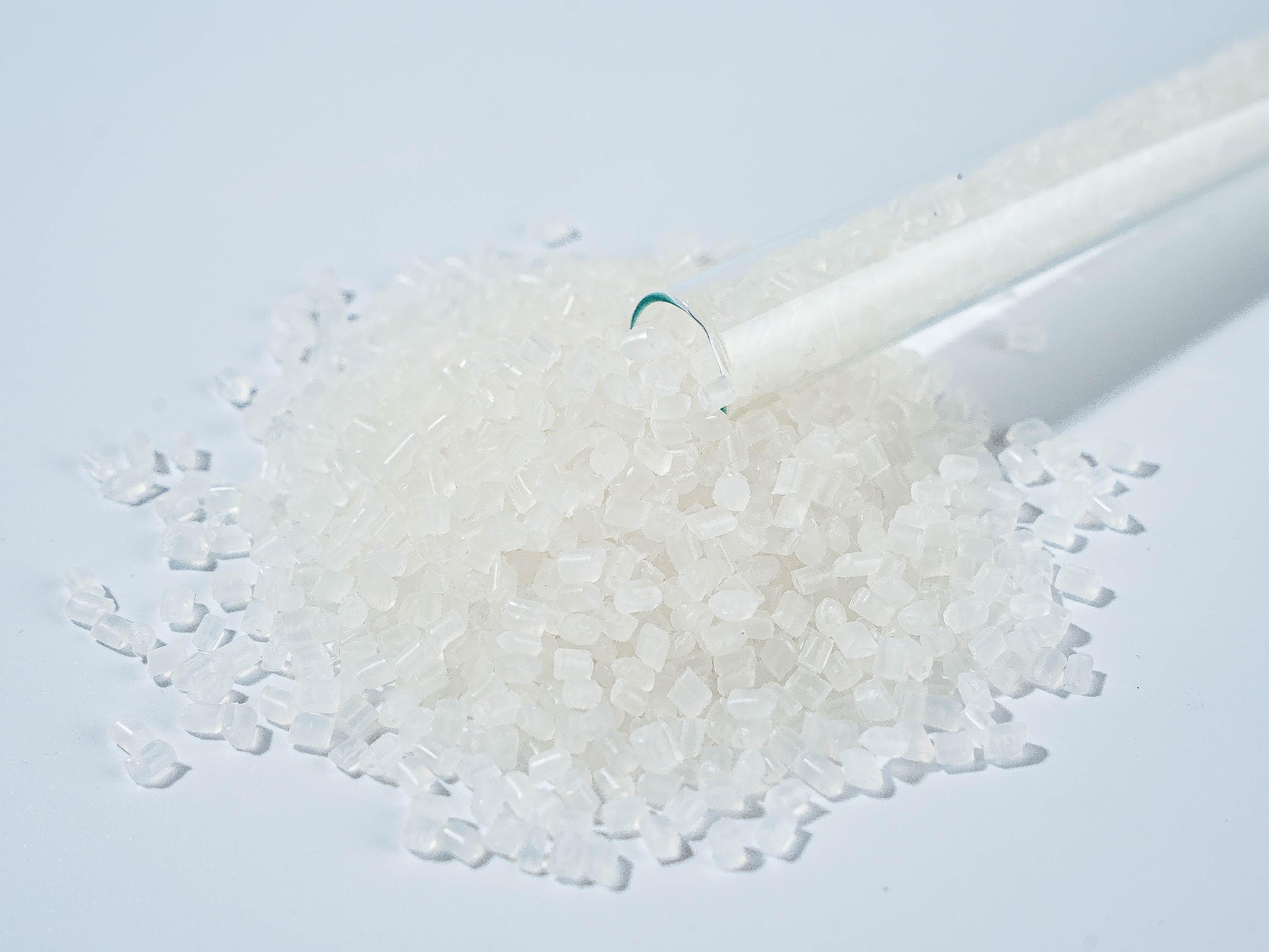
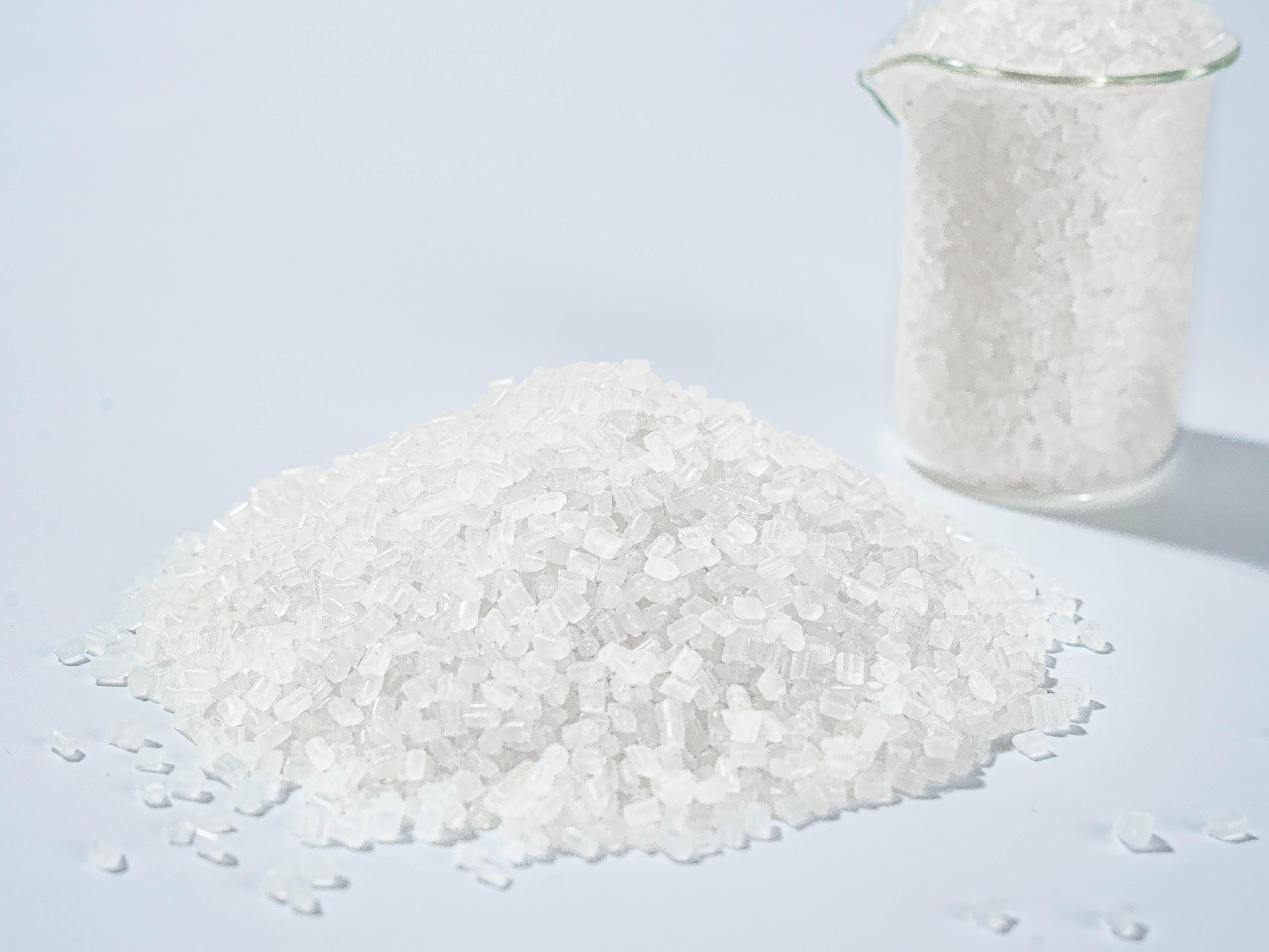
This product is a functionalized polymer material with a hydrogenated styrene-butadiene-styrene triblock elastomer (SEBS) as the main chain and glycidyl methacrylate (GMA) side groups introduced through controlled grafting polymerization technology. Its chemical structure can be expressed as SEBS-g-GMA. The design intent of this graft copolymer is to organically combine the inherent high elasticity and weather resistance of SEBS with the epoxy reactive groups provided by GMA, thereby building a "molecular bridge" between physical toughening and chemical compatibilization. No mineral oil or any plasticizing component is added throughout the product, ensuring its thermal processing stability and non-bleeding characteristics during service.
Product Appearance: Light yellow rubber pellets
Product Performance:
Highly reactive epoxy groups: GMA grafting degree ≥0.8%, with abundant epoxy functional group density. In the molten state, it can rapidly undergo ring-opening addition with –COOH, –NH₂, –OH and other groups, achieving efficient chemical coupling.
Oil-free formulation, long-term stability: Contains no plasticizing oil or mineral oil. There is no oil bleed risk during high-temperature processing or long-term use. The article surface always remains dry, and performance decay is extremely low.
Excellent interfacial chemical bridging capability: Through in-situ covalent bonds, strong "anchoring points" are constructed at the interface of incompatible two phases, greatly reducing interfacial tension, significantly improving stress transfer efficiency, and markedly increasing interfacial peel strength.
Compatibilization effect superior to traditional grafted products: For systems with large polarity differences such as polyolefin/polyester and polyolefin/polyamide, its dispersed-phase refinement capability and phase morphology stability exceed those of SEBS-MAH products, resulting in a more uniform alloy microstructure.
Balanced stiffness-toughness comprehensive reinforcement: While improving compatibility, it simultaneously improves the notched impact toughness, elongation at break, and tensile strength of blends, and heat aging resistance is also improved, making it suitable for long-term thermal service applications.
Wide thermal processing adaptability: It maintains stable activity within the range of 170–260°C. The melt flow rate is moderate (2.5±1.5 g/10 min), which facilitates dispersion and reaction while offering good process convenience.
Combines elasticity and polar reactivity: It retains the high elasticity, low-temperature flexibility, and weather resistance of SEBS, while imparting chemical affinity to polar components. One additive serves multiple functions, simplifying formulation design.
Typical Applications:
Polyolefin/polyester alloys (PP/PE + PET/PBT): During melt blending, epoxy groups react in situ with polyester terminal carboxyl groups to form graft copolymers. These copolymers act as an "emulsifier" in situ, effectively inhibiting dispersed-phase agglomeration. The notched impact strength of the alloy can be increased by 2–3 times (based on typical formulations).
Super-toughening of polyesters (including recycled materials): To address the high brittleness of PET or PBT, this product uses reactive toughening to greatly improve crack resistance without significantly sacrificing modulus and heat deflection temperature. It is suitable for injection-molded parts such as automotive connectors and power tool housings.
Reactive toughening of polyamides: For PA6/PA66 systems, epoxy groups react with amide end groups to form chemically bonded elastomer microparticles. Its toughening efficiency is about 40% higher than simple physical blending with SEBS, and the decrease in melt index is controllable, facilitating injection molding filling.
Reinforcement of filled polypropylene/polyethylene: It improves the stress transfer efficiency between inorganic fillers such as glass fiber and talc and the matrix, simultaneously increasing flexural strength and impact strength, and avoiding toughness loss when traditional coupling agents are used alone.
Tie layer for multilayer composite structures: It can be used alone or blended with other resins as an intermediate tie layer for coextruded films/sheets, providing durable and aging-resistant interlayer adhesion.
Technical Parameters:
Property | Value | Unit | Test Method |
Color | Light yellow | N/A | Visual |
Density | 0.93-0.95 | g/cm³ | ASTM D792 |
Melt Flow Rate (190°C/2.16 kg) | 2.5±1.5 | g/10 min | GB/T 3682.1/2018 |
Grafting degree | ≥0.8 | % | Acid-base titration |
Note: The above data are typical test values and should not be interpreted as specification limits.
Recommended Addition Level:
The addition level of SEBS-GMA depends on the polarity difference and reaction requirements of the target system. The generally recommended addition range is 3%–10% of the total formulation. For systems with extremely poor interfacial compatibility or requiring strong chemical bonding, the optimal addition ratio should be determined through testing.
Processing Recommendations:
This product has good thermal stability, and the recommended processing temperature range is 170°C–260°C. It is recommended to avoid prolonged exposure to temperatures above 260°C to prevent loss of epoxy group activity or decomposition. The final processing temperature should be optimized according to the specific formulation, equipment type, and process conditions. A small-scale trial is recommended before mass production.
Packaging and Storage:
Packaging: Paper-plastic composite packaging, 25 kg/bag. During transportation, avoid moisture, contamination, and direct sunlight.
Storage Conditions: Store in a cool, dry, well-ventilated warehouse, away from direct sunlight, fire sources, and heat sources. Avoid direct contact with strong acids, strong bases, and amine compounds to prevent premature reaction and failure. This product has a certain degree of hygroscopicity. After opening, please use it as soon as possible. If not used up, it must be strictly sealed to prevent moisture from affecting processing stability and reactivity.
Shelf Life: 12 months from the date of production under original unopened packaging and proper storage conditions.
Safety Precautions: Maintain ventilation during high-temperature processing and avoid inhaling possible trace fumes. Wear protective gloves and goggles during operation. Do not place together with flammable or corrosive materials. For specific safety information, please refer to the product's Safety Data Sheet (SDS).
Grade Selection Support:
For different application scenarios, this series offers multiple grades. For precise grade selection, please contact our sales engineer to recommend the best solution.